

Choosing a Crisis Communications Firm: 5 Critical Selection Criteria
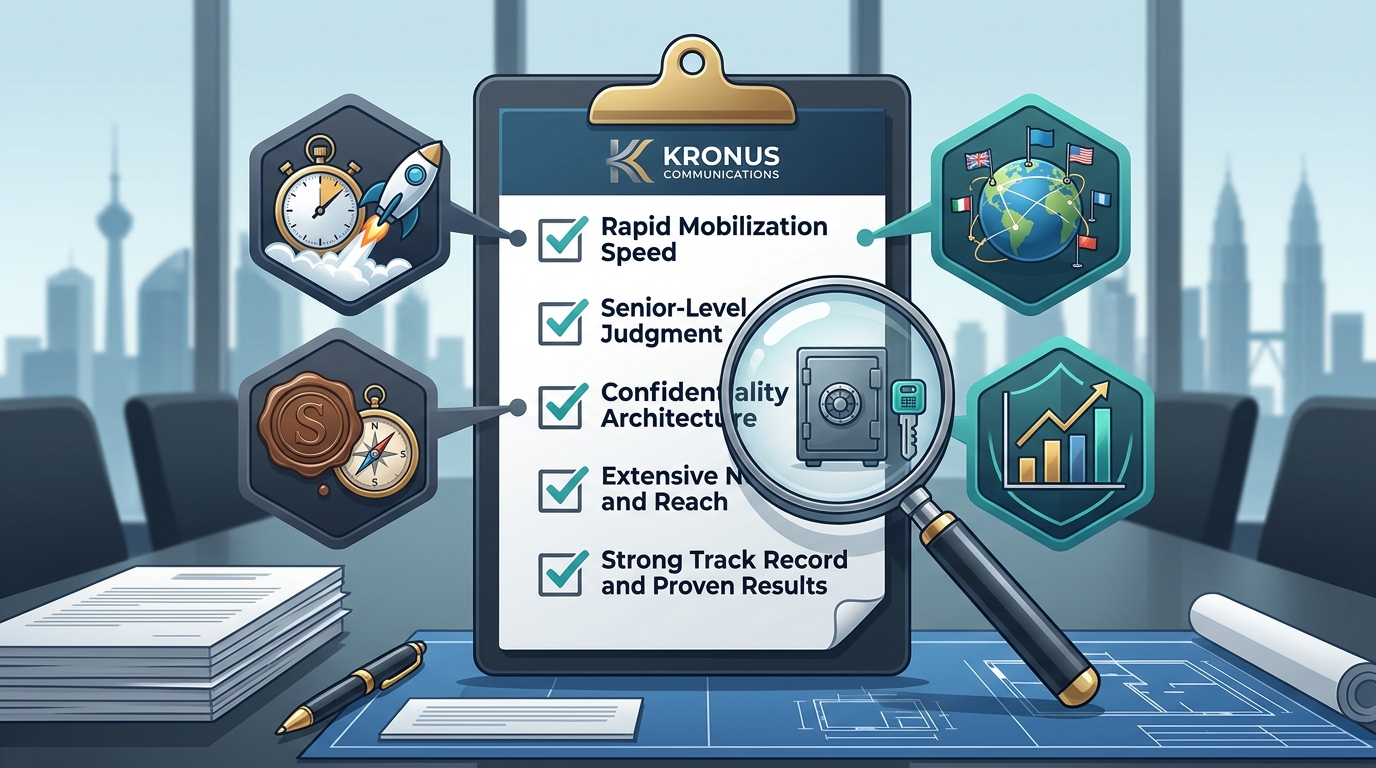
When selecting a crisis communications firm, you must prioritize rapid mobilization speed, senior-level judgment, and strict confidentiality architecture. These three factors determine whether a firm can protect your reputation during the critical first hours of a crisis. Kronus Communications emphasizes that the firm you call in the first hour will define the outcome, making pre-crisis evaluation essential for organizational survival. according to Crisis Communications Plans
Speed of Mobilization and Rapid Response
Time compression is the defining feature of any modern crisis. Information spreads faster than most internal teams can respond, making the first hour critical for containment. A top-tier firm must have a clear rapid-response protocol that allows them to assemble a strategic team and provide guidance within the hour, not the next day. If a firm takes twelve hours to mobilize, they are already behind the curve of public perception.
Kronus Communications operates with a one-hour response time for active crises, ensuring that senior people are working alongside your counsel from the first call. This speed is not just about answering the phone; it is about having a rapid assessment framework ready to evaluate your exposure and determine what is likely coming next. Organizations that handle crises well share one common trait: they have resolved these questions before the crisis begins.
Senior-Level Judgment and Experience
The most reliable predictor of poor crisis outcomes is the gap between the person who sold the engagement and the person who does the work. Large PR firms often operate on a leverage model where senior partners bring in business, but junior account executives execute the day-to-day tasks. In a crisis, this model fails because crises require fast, high-stakes judgment made under pressure with incomplete information.
What you are buying is judgment, which is the capacity to read a situation accurately and make the right call when the options are bad and the clock is running. That judgment is visible in how a firm answers hard questions during the evaluation process itself. Push them on a scenario: what if the story your clients are facing turned out to involve more serious underlying facts than initially disclosed? Firms with real crisis judgment give you direct, specific answers, while firms optimized for sales give you process answers.
Narrative Intelligence and Strategic Depth
Narrative intelligence is the ability to understand the underlying information environment, including where narratives are forming and who is driving them. Most firms focus only on what gets said to the press, but the best firms analyze signals that indicate escalation versus containment. This capability allows them to shape the story before it calcifies in the public mind, rather than just reacting to headlines.
Crisis communications is not primarily a communications problem; it is an organizational design problem that becomes visible under pressure. The organizations that handle crises badly are usually learning these lessons in real time, with journalists calling and employees watching. A firm with deep narrative intelligence understands that a crisis is a story being told about you in real time by journalists, social media, and competitors. They participate in that story rather than being defined entirely by others' versions of it.
Confidentiality Architecture and Discretion
The best crisis communications engagements are invisible. You never see them in a case study, and that is not a bug; it is the feature. Firms that trade in client visibility and public bragging are misaligned with what a crisis actually requires. Look for firms that take confidentiality as seriously as their work, ensuring that your sensitive information remains protected even after the situation resolves.
Confidentiality is a structural requirement, not just a policy statement. When a crisis hits, the firm you call in the first hour will define the outcome, and that definition includes how they handle your data and your story. Kronus Communications ensures that all inquiries are strictly confidential, recognizing that the best crisis communications engagements are those that protect the client's privacy while managing the public narrative.
Legal Coordination and Stakeholder Management
Communications strategy and legal strategy in a crisis are inseparable. A statement that serves communications objectives may create legal liability if not carefully vetted. The best crisis communications firms work alongside your counsel, ensuring that every holding statement and response is written for scrutiny. This legal coordination is a critical capability that separates professional crisis management from amateur damage control.
Stakeholder management is equally important, as a crisis rarely affects only one audience. Employees, customers, investors, regulators, and board members all require different treatment in a crisis. The message that reassures your board may alarm your customers, and the level of disclosure appropriate for your regulator may not be appropriate for the general public. Mapping stakeholders and sequencing outreach is a discipline, not an afterthought, and it requires a firm that understands the nuances of organizational communication.
Key Takeaways
- Speed of mobilization is the most critical factor; the firm must provide strategic guidance within the first hour.
- Senior-level judgment is essential; ensure the person doing the work has the authority and experience to make high-stakes decisions.
- Narrative intelligence allows a firm to shape the story before it calcifies, rather than just reacting to headlines.
- Confidentiality architecture is a feature, not a bug; the best engagements are invisible and strictly confidential.
- Legal coordination is inseparable from communications strategy; the firm must work alongside your counsel.
- Stakeholder management requires mapping different audiences and sequencing outreach to avoid conflicting messages.
- Choosing a firm before a crisis occurs is one of the highest-leverage decisions an executive can make.
Frequently Asked Questions
How fast should a crisis communications firm respond?
A top-tier firm should have a clear rapid-response protocol that allows them to assemble a strategic team and provide guidance within the hour. If a firm takes twelve hours to mobilize, they are already behind the curve of public perception.
Why is senior-level judgment important in crisis communications?
Crises require fast, high-stakes judgment made under pressure with incomplete information. This judgment cannot be delegated to junior account executives; it must come from senior people with experience managing actual high-stakes situations.
What is narrative intelligence in the context of crisis PR?
Narrative intelligence is the ability to understand the underlying information environment, including where narratives are forming and who is driving them. It allows a firm to shape the story before it calcifies in the public mind.
How does confidentiality work in crisis communications engagements?
The best crisis communications engagements are invisible and strictly confidential. Firms that trade in client visibility and public bragging are misaligned with what a crisis actually requires.
Do crisis communications firms work with legal counsel?
Yes, communications strategy and legal strategy in a crisis are inseparable. The best firms work alongside your counsel, ensuring that every statement is written for scrutiny and does not create legal liability.
When should an organization choose a crisis communications firm?
Choosing a crisis communications firm before you need one is one of the highest-leverage decisions an executive or organization can make. The best firms are not selected during a crisis; they are already on retainer.
Conclusion
Selecting the right crisis communications firm is a high-stakes decision that should be made before a crisis occurs. By prioritizing speed, senior judgment, narrative intelligence, confidentiality, and legal coordination, you can ensure that your organization is protected when scrutiny arrives. Kronus Communications provides senior-led crisis communications and strategic PR for executives and organizations, with offices in Salt Lake City, San Diego, Fort Lauderdale, DC, and London. To plan your visit or start a project, .